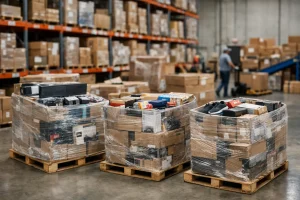
If you have ever bought a “deal” electronics pallet and ended up with 40 phone cases, 12 mystery cables, and one cracked tablet, you already know the truth: the margin is real, but only when you buy with a plan.
Wholesale liquidation pallets electronics can be one of the fastest ways to build inventory for eBay, Amazon, Walmart Marketplace, Facebook Marketplace, or a local shop. They can also be one of the easiest ways to tie up cash in slow-moving, untestable, or incomplete items. The difference is not luck. It is understanding how electronics liquidation works, what to look for before you pay, and how you will sell the lot after it lands.
Why electronics pallets can beat “regular” wholesale
Electronics resell well because demand is steady and shoppers price-compare aggressively. That is good for you when your buy cost is low enough to undercut retail while keeping profit.
Liquidation pallets come from overstock, shelf pulls, returns, and closeouts. The value comes from the spread between what the retailer needs to recover quickly and what you can earn by breaking the pallet down and selling item-by-item. With electronics, that spread can be meaningful because a single working device can cover a big chunk of your pallet cost.
The trade-off is risk. Electronics are more condition-sensitive than most categories. Missing chargers, locked accounts, cracked screens, water damage, and “works but…” issues can turn a great manifest into a headache. So you do not buy electronics liquidation like you buy household essentials. You buy it like a tester, a merchandiser, and a pricing strategist.
What “electronics liquidation” usually includes (and what it doesn’t)
A lot of new buyers imagine every pallet is stacked with high-end phones and laptops. In reality, pallets are often mixed within the electronics lane. You might see:
- Consumer devices like tablets, headphones, smartwatches, cameras, and speakers
- Accessories like chargers, cases, cables, mounts, screen protectors, keyboards, and mice
- Smart home items like streaming sticks, routers, smart bulbs, doorbells, and hubs
- Small appliances that retailers file under electronics, like electric toothbrushes or grooming kits
What you should not assume: original boxes, complete accessories, clean IMEI status, or that anything is tested. Some lots are better than others, but you should treat every pallet like it will require labor.
The key variable: condition codes and what they mean for your margin
Most electronics liquidation is sold with some kind of condition description. The exact terms vary by supplier, but your profit depends on not overpaying for the wrong grade.
New or overstock lots are the simplest. They are typically returns-light, easier to list, and have fewer hidden problems. They cost more upfront, but they can be the best choice if you want fast turnaround and fewer customer service issues.
Shelf pulls can be great when they are truly pulled from retail shelves and not heavily handled. They may have damaged packaging, missing manuals, or scuffs. Your listing work is manageable, and your return rate is usually lower than customer returns.
Customer returns are where the upside and the risk live. The buy cost can be very attractive, and you can hit big winners. But you are buying a workload: testing, sorting, cleaning, verifying parts, and deciding what is worth selling, what is worth repairing, and what should be bundled or parted out.
Salvage is a different game. Salvage pallets can still be profitable if you have repair capability, parts buyers, or a strong local secondary market. If you are new, salvage is where cash disappears slowly.
It depends on your model. If you want to scale and keep processes clean, you lean toward new, overstock, and light returns. If you have technical skills, time, or a repair partner, you can take on more returns and salvage.
Manifests: helpful, but not a guarantee
Some pallets come with a manifest, some do not. A manifest can speed up your pricing and help you estimate value, but it is not a promise of condition, completeness, or even exact quantities.
When you do have a manifest, use it to build a realistic “expected recovery,” not a best-case fantasy. A practical approach is to estimate recovery by categories. Assume your top items sell, assume some items need discounts, and assume a portion is dead or incomplete.
If you do not have a manifest, your advantage comes from buying from a supplier with consistent grading and customer support, and from keeping your buy price conservative enough that you can still profit even if the mix leans accessory-heavy.
What to check before you buy wholesale liquidation pallets electronics
A profitable buy happens before checkout. After checkout, you are just managing what you already agreed to.
Start with your selling channels. If most of your sales are on Amazon, you may need more new-in-box product and fewer untested returns. If you sell locally, you can move more “open box, tested, discounted” items quickly. If you sell on eBay, you can do well with returns as long as you are precise about condition and you test honestly.
Then look at your operational reality. Do you have space to sort? Do you have time to test? Do you have the cash to wait for slower items to sell? Electronics liquidation rewards speed. The longer inventory sits, the more it costs you in time and opportunity.
Also check shipping and total landed cost. Freight, liftgate needs, and delivery scheduling affect your real cost per unit. A pallet that looks cheap can get expensive when you add freight and handling.
Your testing and triage process matters more than your listing skills
If you want repeatable profit from electronics pallets, build a routine you can do every time the pallet arrives.
First, separate by type: devices, accessories, smart home, and “unknown.” Then triage by obvious condition: sealed, open box, used, damaged. Your goal is to identify your fast flips early.
For devices, do quick functional checks: power on, charging, basic screen response, buttons, ports, Wi-Fi or Bluetooth where applicable, and factory reset. For anything that can be account-locked, verify status before you invest time in photos and listings.
For accessories, bundle intelligently. Single low-dollar cables can be slow. Multi-packs, variety bundles, or “lot of 10” listings can move faster and reduce your labor per dollar earned.
Decide upfront what you will not mess with. If you know you will not repair cracked screens, do not let “maybe I’ll fix it” items pile up. Move them as parts or locally to recover cash.
Pricing: protect your margin without killing velocity
Electronics shoppers know prices. If you list too high, you sit. If you race to the bottom, you work for free.
A practical target is to price based on your testing level and return tolerance. If you fully test and include accessories, you can price closer to the top of the used market. If you do basic testing only, price to move and be clear in your description.
You also want to factor in the hidden costs: platform fees, shipping supplies, returns, and your own labor. A $25 profit on paper can turn into $8 when you account for time and return shipping.
Velocity is a strategy. Sometimes the best move is to take smaller margins to convert inventory into cash you can reinvest into better lots.
How to avoid the most common electronics pallet mistakes
The biggest mistake is buying based on retail MSRP instead of resale reality. A manifest full of “$199” items does not matter if the used market clears at $59 and half the units are incomplete.
The second mistake is ignoring accessories. Pallets with too many low-value accessories can still be profitable, but only if you have a bundling plan and you are comfortable with high-volume, low-dollar listings.
The third mistake is skipping process. Without a repeatable intake, testing, and listing workflow, a pallet becomes a messy pile. Mess kills turnaround, and turnaround is where liquidation profit lives.
Finally, many buyers scale too fast. It is tempting to jump from one pallet to ten. But electronics require time. Scale after you know your recovery rate, your return rate, and your cash cycle.
Picking a supplier that supports resellers
Electronics liquidation is not just about finding “cheap pallets.” It is about consistency and being able to buy again with confidence.
Look for a supplier that clearly describes pallet types, offers category-specific options when you want them, and has support when you need help choosing between lots. If you are building a long-term reselling business, supplier relationships matter because they reduce surprises over time.
If you want a simple way to buy pre-built pallets across electronics and other categories, Wholesale Pallet Liquidators is built for resellers who care about margin, fast turnaround, and ordering support, whether you are buying a single pallet or stepping up to bulk.
A realistic way to start if you’re new
If you are new to wholesale liquidation pallets electronics, start with a pallet size and condition level that matches your time, not your ambition. Your first win is not “scoring” a unicorn pallet. Your first win is building a repeatable workflow and proving you can recover your cash predictably.
Choose a lot where you can test most items with basic tools, keep your listings honest, and move inventory within a few weeks. Track your numbers: landed cost, sell-through rate, average profit per unit, and returns. After two or three pallets, you will know whether you should go more device-heavy, more accessory-heavy, or switch to higher-grade inventory.
The best part about electronics liquidation is that you can improve quickly. Each pallet teaches you what sells fastest in your channels, what brands create the fewest headaches, and where your time is best spent. Keep your process tight, buy with your calculator instead of your emotions, and treat every pallet like the start of a repeat purchase, not a one-time gamble.
OUR AVAILABLE PALLETS
Bulk Accessories Pallets For Sales | Wholesale Mixed Accessories
Bulk Accessories Pallets For Sales | Wholesale Mixed Accessories
Funko Pop Pallets | Wholesale Collectible Vinyl Figures
Cheap Wholesale Video Game Pallets
EarPods Pallets Wholesale – Bulk Deals for Resellers
General Merchandise Pallets Wholesale
Wholesale Hunting & Fishing Gear Pallets
Liquidation Power Tool Pallets
Makeup and Beauty Pallets Wholesale
Mixed Electronics Pallet Wholesale
Pokémon Card Pallets Wholesale | Sealed Pokémon TCG Pallets
Sports Card Pallet Wholesale Premium Bulk Trading Cards
Stanley Cups Pallet | Bulk Insulated Tumblers for Resale
Detergent Pallets Wholesale | Bulk Laundry Supplies
Wholesale Kitchen Appliances Pallet