The Select Source vs. Other Liquidation Suppliers: Who Actually Wins the Pallet Wars?
Let’s be honest: nobody grows up dreaming of becoming a liquidation pallet connoisseur. And yet here you are, googling supplier comparisons at 11 p.m. with seventeen browser tabs open, trying to figure out why one pallet costs $300 and another “identical” pallet costs $2,400 and may or may not contain a working blender. Welcome to the club. We have jackets. They’re mystery-box jackets, so we’re not entirely sure what size you’ll get.
This guide breaks down The Select Source vs. Other Liquidation Suppliers the way a friend would explain it to you over coffee — if that friend happened to spend an unreasonable amount of time studying wholesale liquidation pallets, manifests, and the emotional rollercoaster of online bidding wars. By the end, you’ll know exactly what a straightforward, fixed-price liquidation pallet supplier offers versus what you’re signing up for on the big auction marketplaces, and you’ll be able to shop with the quiet confidence of someone who has finally read the terms and conditions.
We’re going to cover what “the select source” approach to liquidation actually offers buyers, how inventory and pricing compare across the industry, the honest pros and cons for resellers, a checklist for vetting any liquidation pallet supplier, and where auction-style alternatives with verified manifests still make sense. Grab a coffee. Or a Stanley cup, because apparently everyone owns eleven of them now.
What “The Select Source” Approach Offers Buyers
Think of “the select source” model — the fixed-price, browse-and-buy style of wholesale liquidation pallets marketplace — as the difference between a vending machine and a livestock auction. Both get you food eventually. Only one involves shouting.
Here’s what that model typically offers:
- Fixed, visible pricing. You see a number, you like the number (or you don’t), you buy or you don’t. No last-second sniping from a stranger named “PalletKing2019” who really, really wants that Labubu Mystery Figure Pallets lot.
- Buy Now or Make an Offer flexibility. Some listings let you negotiate instead of committing to a price war with your own patience.
- Direct access to categorized inventory across electronics, apparel, tools, collectibles, and general merchandise — instead of digging through a single mega-catalog sorted by “who knows.”
- Flexible payment options, including wire transfer for bulk orders and even bitcoin, for buyers who’d rather not wait three business days for a check to clear.
- Support that actually responds when you have a question about a pallet, rather than a support ticket that vanishes into the void like your gym motivation every January.
- Domestic and international shipping, including freight and container loads for buyers scaling past the “trunk of my car” phase of reselling.
This is the core of what makes the “select source” model different: it removes the auction anxiety and replaces it with a straightforward shop-and-checkout experience, which matters a lot more than it sounds like it should when you’re trying to build a resale business instead of a gambling habit.
The Select Source vs. Other Liquidation Suppliers: How Inventory and Pricing Compare
This is the part of The Select Source vs. Other Liquidation Suppliers debate everyone actually cares about: money. So let’s talk money, and let’s talk it in a way that doesn’t require a finance degree or a nervous breakdown.
The wider liquidation pallet supplier landscape generally splits into two camps:
1. Fixed-price marketplaces (the “select source” style) You see a listed price. Categories are typically priced anywhere from around $300 for smaller specialty lots up to $750+ for denser categories like power tools, kitchen appliances, or trading card pallets. What you see is (mostly) what you pay — no surprise fees tacked on at checkout.
2. Auction-format marketplaces — the model used by platforms like Direct Liquidation and Liquidation.com Here, pallets are listed with a manifest and buyers bid against each other, with the final price determined by however competitive the bidding gets that day. On top of the winning bid, buyers frequently pay a buyer’s premium, commonly in the 10–15% range, plus applicable fees. Pricing on these platforms can range widely — often somewhere between $50 and $2,000+ per pallet depending on category, retailer source, and how badly three other resellers wanted the same lot of blenders you did.
Here’s the quick-glance version:
| Factor | Fixed-Price Model (Select Source style) | Auction Marketplaces (e.g., Direct Liquidation, Liquidation.com) |
|---|---|---|
| Pricing | Set price, visible upfront | Variable, decided by bidding |
| Extra fees | Typically none beyond shipping | Buyer’s premium often applies (10–15%) |
| Time investment | Add to cart, done | Monitor listings, place bids, wait for auction close |
| Predictability | High — you know your cost before buying | Lower — final cost depends on competing bidders |
| Manifest detail | Varies by listing, category-based | Often itemized/manifested, especially on retailer-branded lots |
| Best for | Resellers who want speed and budget certainty | Resellers chasing specific high-manifest-confidence lots and willing to negotiate through bidding |
The honest takeaway: auction platforms can be excellent when you want a heavily itemized manifest and are comfortable competing for it. Fixed-price suppliers win when you want to know your total cost before your coffee gets cold and skip the bidding-war adrenaline entirely.
Pros and Cons for Resellers
No supplier model is perfect, and anyone who tells you otherwise is probably trying to sell you a “guaranteed profit” webinar. Here’s the real list.
Pros of a fixed-price liquidation supplier:
- Budget certainty — the price you see is the price you pay, so your margin math doesn’t require a crystal ball
- Faster purchasing decisions, since there’s no auction countdown clock stressing you out
- Simpler for beginners who are still learning how liquidation inventory works
- Easier to plan bulk or repeat orders since pricing doesn’t fluctuate with bidder demand
- Often better suited to niche, trending categories (think Pokémon Card Pallets Wholesale or Wholesale Magic The Gathering Cards Pallet) where fixed listings move faster than auctions can
Cons of a fixed-price liquidation supplier:
- Inventory availability changes fast — see something you like, buy it, because liquidation stock does not wait for indecisive people
- Manifest depth can vary by listing, so due diligence is still on you
- Less room for aggressive lowballing compared to some auction dynamics
Pros of auction-format suppliers:
- Frequently strong, itemized manifests, especially on retailer-branded portals
- Potential to win a lot below its estimated value if bidding is quiet
- Large inventory volume across many categories and retailers
Cons of auction-format suppliers:
- Buyer’s premiums and fees stack onto your winning bid
- Popular lots can get bid up past what they’re actually worth
- Requires more time monitoring listings and auction close times
- Final cost is unpredictable until the gavel (metaphorically) drops
If you’re the type of reseller who likes surprises, auctions might scratch that itch. If you’re the type who likes knowing your numbers before you commit — which, statistically, is most people running an actual business and not a hobby — a fixed-price liquidation pallet supplier tends to be the less stressful path.
What to Look for in a Liquidation Supplier
Whether you go fixed-price or auction, whether you pick “the select source” style or something else entirely, here’s your non-negotiable checklist. Screenshot it. Tattoo it. Whatever helps.
- Manifest transparency. Even when a listing isn’t fully itemized, you should get clear category, condition, and quantity information before you buy — not just a stock photo and a prayer.
- Clear pricing structure. Know whether you’re paying a flat price or whether bidding fees, buyer’s premiums, or other charges apply on top.
- Real customer support. A supplier should answer questions about a pallet before you buy it, not just after you’ve already filed a complaint.
- Shipping clarity. Freight costs, delivery timelines, and international shipping terms should be spelled out — not discovered when your invoice arrives.
- Payment security. Reputable liquidation pallet supplier operations offer secured payment methods and are upfront about wire transfer or bulk-order terms.
- Return and refund policy. Liquidation goods are generally sold as-is, but a supplier should still be transparent about what “as-is” actually covers.
- Track record and reviews. Repeat customers and consistent service history matter more than a flashy homepage.
- Category consistency. A supplier who regularly restocks the categories you resell (electronics, collectibles, apparel, tools) is more valuable long-term than a one-time low price.
A supplier that checks all eight boxes is doing the heavy lifting for you. A supplier that dodges questions about manifests is doing the heavy lifting for your future customer service inbox, and not in a good way.
Popular Pallet Categories You Can Shop Right Now
Part of what makes the “select source” model appealing is sheer category variety — you’re not stuck choosing between “general merchandise” and “more general merchandise.” Here’s a sample of what a well-stocked wholesale liquidation pallets marketplace can look like:
- Funko Pop Pallets — for the collector-market reseller who knows exactly which figures fly off shelves
- Hot Wheels Pallet For Sale — small items, big margins, minimal storage headaches
- LEGO Pallet Wholesale — a category that basically never goes out of style, much like stepping on it barefoot
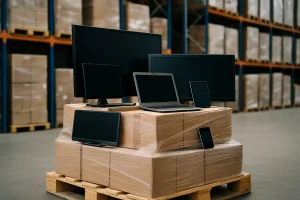
- Mixed Electronics Pallet Wholesale — higher price point, higher resale ceiling
- Liquidation Power Tool Pallets — for resellers who want buyers who are, statistically, less likely to haggle
- Wholesale Kitchen Appliances Pallet — everyone needs a blender, especially the ones who broke their last one making smoothies at 6 a.m.
- Makeup and Beauty Pallets Wholesale — fast-moving inventory for online and marketplace sellers
- Stanley Cups Pallet — because apparently the tumbler economy shows no signs of slowing
- General Merchandise Pallets Wholesale — the reliable, mixed-bag option for resellers who like variety
- Wholesale Mixed Toy Pallets — evergreen demand, especially heading into gift-giving seasons
- Cheap Wholesale Video Game Pallets — a category that resells itself to a very specific, very passionate customer base
- Bulk Accessories Pallets For Sale — low cost of entry, decent margin for online sellers
- EarPods Pallets Wholesale — small, light, and easy to ship in volume
- Wholesale Hunting & Fishing Gear Pallets — a niche category with a loyal, less price-sensitive buyer base
- Detergent Pallets Wholesale — unglamorous, consistently needed, and consistently profitable
- Sports Card Pallet Wholesale and its sibling listing, the Sports Card Pallets Wholesale – Sealed Trading Cards lot — for resellers riding the trading card resurgence
Bulk category variety like this is exactly why “the select source” model appeals to resellers who don’t want to specialize in one narrow niche, but instead want the flexibility to test new categories as trends shift — without waiting for an auction to end to find out if they won.
Alternatives With Verified Manifests and Support
To be fair — and we like to be fair, even in an article that is, admittedly, rooting for the home team — auction-style platforms with verified manifests absolutely have a place in a reseller’s toolkit.
Direct Liquidation operates primarily as an auction marketplace, offering itemized manifests on many listings and working with recognizable retail sources. It can be a strong fit for resellers who want detailed, line-by-line manifest data and are comfortable bidding for it.
Liquidation.com is one of the longest-running names in the space, with a large volume of manifested and unmanifested listings across categories like electronics, general merchandise, and furniture. It’s a solid option for resellers chasing large-scale, condition-graded inventory and who don’t mind the buyer’s-premium structure that comes with the auction format.
Both are legitimate parts of the liquidation ecosystem. The difference in The Select Source vs. Other Liquidation Suppliers comparison isn’t “good versus bad” — it’s “predictable and fast” versus “detailed and competitive.” Some resellers use both: fixed-price suppliers for quick, budget-certain category buys, and auction platforms when chasing a specific manifested lot worth the bidding effort.
The smartest resellers don’t marry one supplier. They date around, professionally.
Frequently Asked Questions
Is a fixed-price liquidation supplier better than an auction platform? Neither is universally “better” — a fixed-price liquidation pallet supplier offers predictable costs and faster purchasing, while auction platforms like Direct Liquidation and Liquidation.com often provide more detailed manifests in exchange for bidding time and buyer’s premium fees.
What is a manifest in liquidation pallets? A manifest is an itemized list of what’s supposed to be inside a pallet, often including product names, categories, condition, and estimated retail value, so buyers can make an informed purchase.
Do liquidation pallets come with a warranty? Liquidation merchandise is typically sold as-is. Some items may retain a manufacturer’s warranty, but buyers should confirm this with the specific supplier before purchasing.
How much does a liquidation pallet typically cost? Prices vary widely by category and supplier model, ranging from roughly $300 for smaller specialty pallets to over $2,000 for high-demand or densely packed categories.
Can I make money reselling liquidation pallets? Many resellers do, but profitability depends on sourcing from a transparent supplier, understanding manifest accuracy, and pricing resale items based on realistic market demand rather than guesswork.
Final Verdict
If you’ve made it this far, congratulations — you now know more about The Select Source vs. Other Liquidation Suppliers than roughly 98% of people who type “cheap pallets near me” into a search bar at midnight. The short version: fixed-price suppliers offer speed, budget clarity, and a stress-free checkout experience, while auction marketplaces like Direct Liquidation and Liquidation.com offer detailed manifests in exchange for bidding time and added fees.
Whichever route you choose, vet your supplier, read the manifest, and remember — the goal is building a resale business, not accidentally adopting eleven boxes of earbuds you didn’t mean to bid on.
Ready to skip the bidding war entirely? Browse the current pallet inventory and pick your category without setting an alarm for an auction countdown.